
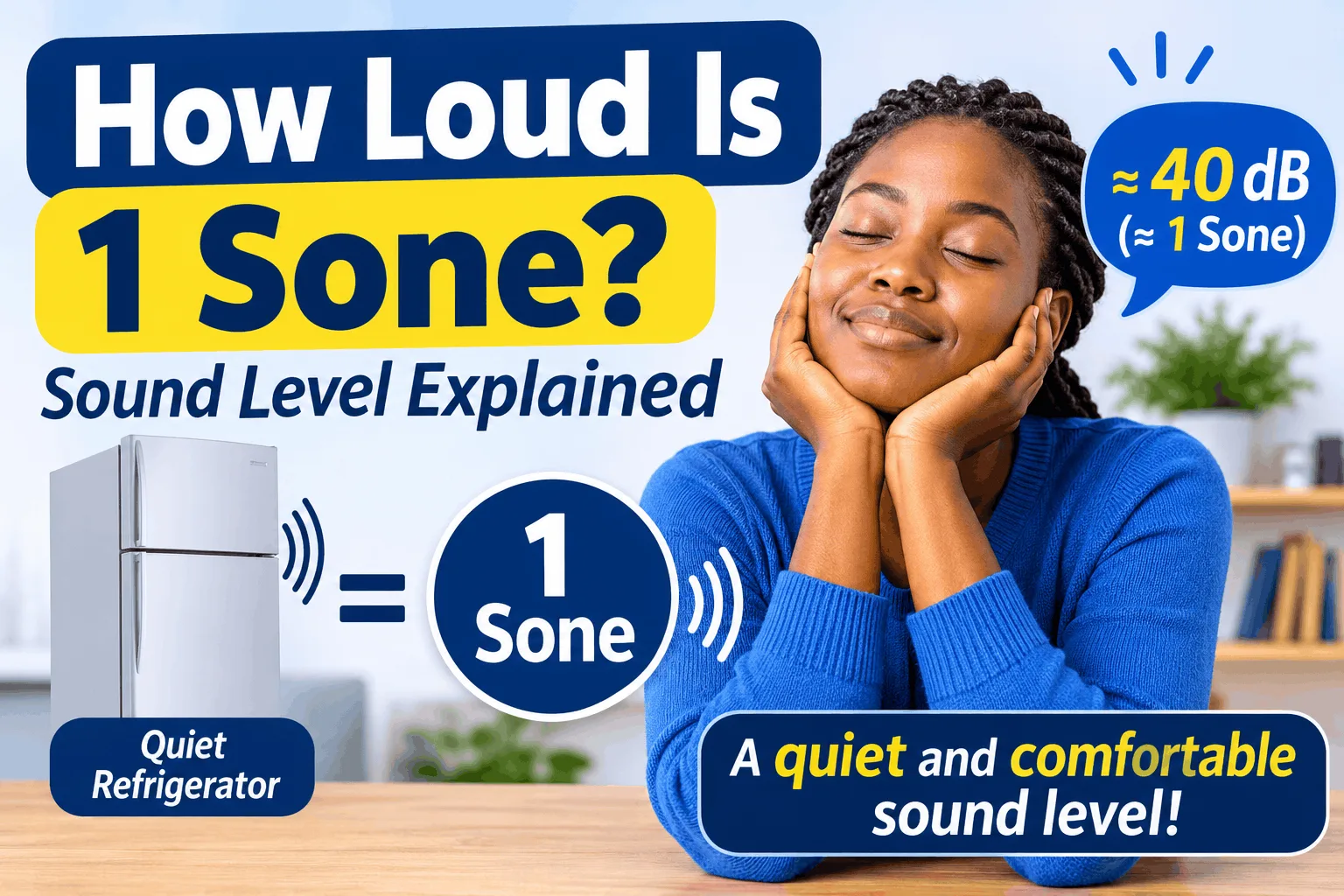
1 sone is a unit of perceived loudness approximately equal to the sound of a quiet refrigerator or a soft background noise in a peaceful room. It represents how loud a sound feels to the average person rather than measuring its physical sound pressure in decibels (dB).
Sones are commonly used to describe the noise levels of household appliances, air conditioners, ventilation systems, range hoods, and other equipment. Understanding what 1 sone sounds like can help you compare appliance noise levels and choose quieter products.
What Does 1 Sone Sound Like?
A sound measuring 1 sone is generally considered quiet and comfortable for everyday environments. It is roughly comparable to the sound of a quiet refrigerator, depending on the appliance and surrounding conditions.
For practical purposes, 1 sone represents a relatively low level of perceived loudness. You may notice it in a quiet room, but it is unlikely to be disruptive during normal activities.
However, perceived loudness varies between individuals and depends on factors such as background noise, distance from the sound source, and the frequency of the sound.
How Many Decibels Is 1 Sone?
One sone is approximately equal to 40 phons, which corresponds to a sound pressure level of approximately 40 dB at 1,000 Hz.
This means 1 sone is roughly equivalent to 40 dB under standard reference conditions.
It is important to understand that sones and decibels measure different aspects of sound:
- Sones: Measure perceived loudness, or how loud a sound feels to a listener.
- Decibels (dB): Measure sound pressure level or sound intensity using a logarithmic scale.
- Phons: Measure perceived loudness level by comparing sounds with a 1,000 Hz reference tone.
For quick conversions, use our Sones to dB Calculator to estimate the decibel equivalent of different sone values.
Is 1 Sone Loud or Quiet?
1 sone is considered quiet. It is a relatively low perceived loudness level and is generally suitable for environments where minimal background noise is preferred.
For example, appliances rated at approximately 1 sone are often suitable for bedrooms, living rooms, and other spaces where noise should remain unobtrusive.
Here is a general guide to understanding different sone levels:
- 0.5 sone: Extremely quiet.
- 1 sone: Quiet and comfortable.
- 2 sones: Noticeable but still relatively quiet.
- 4 sones: Moderately loud.
- 8 sones: Loud and easily noticeable.
- 16 sones: Very loud.
Remember that these descriptions are general guidelines rather than strict measurements of how every person experiences sound.
What Appliances Have a Noise Level of 1 Sone?
Several household appliances are designed to operate at low noise levels. Depending on the model and operating speed, some may produce noise close to 1 sone.
Examples include:
- Bathroom exhaust fans: Some low-noise ventilation fans operate around 1 sone.
- Range hoods: Certain quiet range hood models produce approximately 1 sone at lower fan speeds.
- Air conditioning systems: Some indoor units are designed to operate at relatively low perceived noise levels.
- Refrigerators: Certain modern refrigerators produce low background operating noise, although their noise ratings are not always provided in sones.
Always check the manufacturer’s noise specifications because actual sound levels vary depending on the appliance, installation, and operating conditions.
Is 1 Sone Good for a Bathroom Fan?
Yes. A bathroom exhaust fan rated at 1 sone is generally considered quiet and is a good choice for bathrooms where you want ventilation without excessive noise.
For comparison, a fan rated at 4 sones will sound noticeably louder than one rated at 1 sone.
If you are purchasing a bathroom fan, choosing a model with a lower sone rating can improve comfort, especially in bathrooms near bedrooms or other quiet spaces.
Final Thoughts
1 sone is a relatively quiet sound level, approximately equivalent to 40 dB under standard reference conditions. It is commonly used to describe the perceived noise of household appliances, particularly bathroom fans and ventilation equipment.
When comparing appliances, remember that a lower sone rating generally means quieter perceived operation. Use a Sones to dB Calculator to convert between these two sound measurement units.