
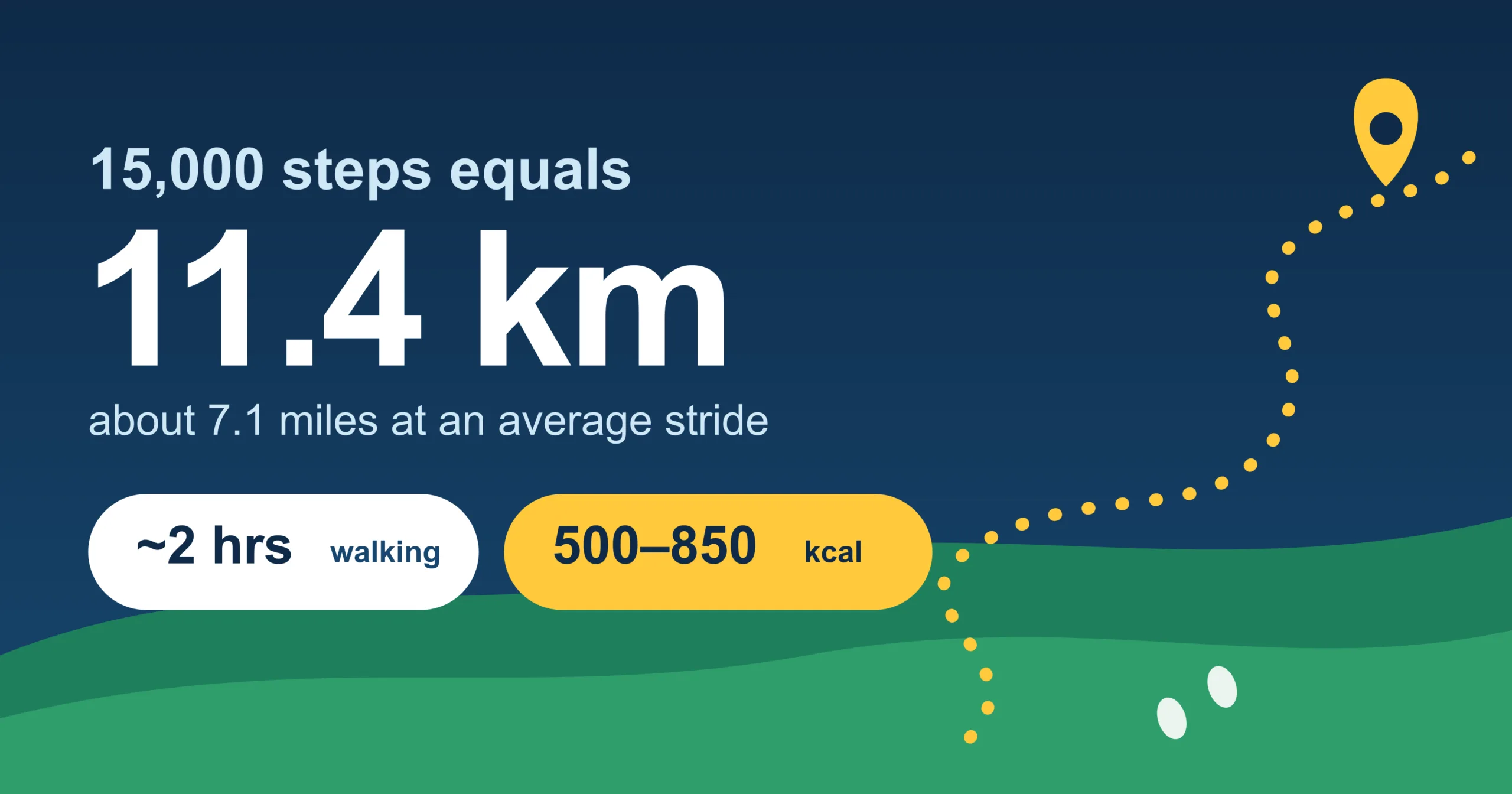
15,000 steps equal about 11.4 kilometers (7.1 miles) for an average adult. It takes roughly 2 to 2.5 hours at a normal pace and burns about 500 to 850 calories, depending on body weight and speed.
Your exact numbers depend on your stride length. Here is how to work out yours.
How Many KM Is 15,000 Steps?
The standard formula is:
Distance (km) = Steps × Stride Length (m) ÷ 1,000
An average adult stride is about 0.762 meters (30 inches), so:
15,000 × 0.762 ÷ 1,000 = 11.43 km
Stride length varies with height, sex, and pace. Taller people cover more ground per step.
| Stride Length | Typical For | 15,000 Steps in KM | In Miles |
|---|---|---|---|
| 0.65 m | Shorter walkers | 9.75 km | 6.1 mi |
| 0.70 m | Average woman | 10.5 km | 6.5 mi |
| 0.762 m | Average adult | 11.43 km | 7.1 mi |
| 0.80 m | Average man / brisk pace | 12.0 km | 7.5 mi |
Find your own stride: multiply your height in meters by about 0.414. A person who is 1.75 m tall has a stride of roughly 0.72 m, which makes 15,000 steps about 10.9 km. Or skip the math and use our Steps to Km converter to get a personalized result in seconds.
How Long Does It Take to Walk 15,000 Steps?
Time depends on your pace. Using the average 11.43 km distance:
| Walking Pace | Speed | Time for 15,000 Steps |
|---|---|---|
| Casual stroll | 3 mph (4.8 km/h) | About 2 hr 25 min |
| Moderate walk | 3.5 mph (5.6 km/h) | About 2 hr |
| Brisk walk | 4 mph (6.4 km/h) | About 1 hr 45 min |
| Power walk | 4.5 mph (7.2 km/h) | About 1 hr 35 min |
You don’t need to do this in one session. Most people collect steps in pieces: a morning walk, errands, a lunch break loop, and an evening stroll. Daily life usually covers 4,000 to 6,000 steps on its own, so a deliberate 60 to 75 minute walk often bridges the gap.
How Many Calories Does 15,000 Steps Burn?
Calorie burn depends mostly on body weight, then speed, terrain, and incline. A heavier body uses more energy to move the same distance.
| Body Weight | Estimated Calories (15,000 Steps, Moderate Pace) |
|---|---|
| 130 lb (59 kg) | 500–550 |
| 155 lb (70 kg) | 600–650 |
| 180 lb (82 kg) | 700–750 |
| 200 lb (91 kg) | 780–850 |
These are estimates based on the standard MET method: calories = MET × body weight (kg) × hours walked. Moderate walking is about 4.3 METs.
A useful reality check: these totals include the calories your body would burn at rest anyway during those 2 hours. The extra calories from walking, often called net burn, are about 25 to 30 percent lower. A 155 lb person would burn closer to 450 net calories. That matters if you’re planning meals around your step count. Many online tables overstate the impact by ignoring this difference.
Ways to burn more:
- Walk faster, because brisk pace raises energy use noticeably.
- Add hills or a treadmill incline.
- Carry a light backpack.
- Mix in short intervals of faster walking.
Health Benefits of Walking 15,000 Steps a Day
Walking is low-impact, free, and easy to sustain. Regular high step counts are linked to:
- Heart health: better circulation, lower resting heart rate, and improved cholesterol numbers.
- Weight management: a steady calorie deficit when paired with sensible eating.
- Blood sugar control: a walk after meals helps muscles use glucose.
- Mood and sleep: time outdoors reduces stress and supports better rest.
- Muscle tone: legs, glutes, and core all work with every step.
Is 15,000 Steps a Day Too Much?
For most healthy adults, no. It is safe if you build up gradually. But more is not always necessary. Large studies suggest the biggest health gains come between roughly 7,000 and 9,000 steps, and benefits keep growing at a slower rate beyond that. The World Health Organization recommends 150 to 300 minutes of moderate activity per week, which is far less than a 15K daily habit.
So who benefits most from 15,000 steps?
- People with desk jobs who want to offset sitting time.
- Anyone aiming for steady weight loss.
- Runners who want volume without impact on rest days.
If you’re new to walking, start from your current average and add 1,000 steps a week. If you have joint problems, a heart condition, or a chronic illness, check with your doctor first. Persistent foot, knee, or hip pain is a signal to scale back.
8 Practical Tips to Reach 15,000 Steps
- Split it up. Aim for three walks of about 5,000 steps.
- Walk after meals. Ten minutes after each meal adds up quickly.
- Take calls on foot. Pace while you talk.
- Park farther away and take stairs whenever possible.
- Use a tracker or phone app to see progress and set hourly reminders.
- Wear supportive shoes with room for your toes.
- Hydrate, especially on warm days or long walks.
- Find a partner or podcast to make time pass faster.
Frequently Asked Questions
How many miles is 15,000 steps?
About 7.1 miles for the average adult stride of 0.762 m. Shorter strides give about 6 miles and longer strides about 7.5.
Is 15,000 steps a day good for weight loss?
Yes, when combined with a modest calorie deficit. Walking alone burns roughly 450 to 700 net calories at this volume, depending on your weight and pace.
How many steps are in a kilometer?
Roughly 1,300 steps per kilometer at an average stride. Brisk walkers take fewer, and shorter people take more.
Is 15,000 steps better than 10,000?
It burns about 50 percent more energy and covers more distance, but the added health benefit per step gets smaller as totals rise. Consistency matters more than hitting a specific number.
How can I measure my exact distance?
Measure your stride over a known distance, such as 10 steps on a measured track, then divide. Or enter your height into a Steps to Km converter for an instant personalized estimate.
Final Takeaway
15,000 steps is about 11.4 km or 7.1 miles, takes around 2 hours at a steady pace, and burns roughly 500 to 850 calories depending on your size and speed. Your own stride length is the key to an accurate distance, so calculate it rather than relying on a one-size-fits-all number. Start where you are, build gradually, and let the habit grow.