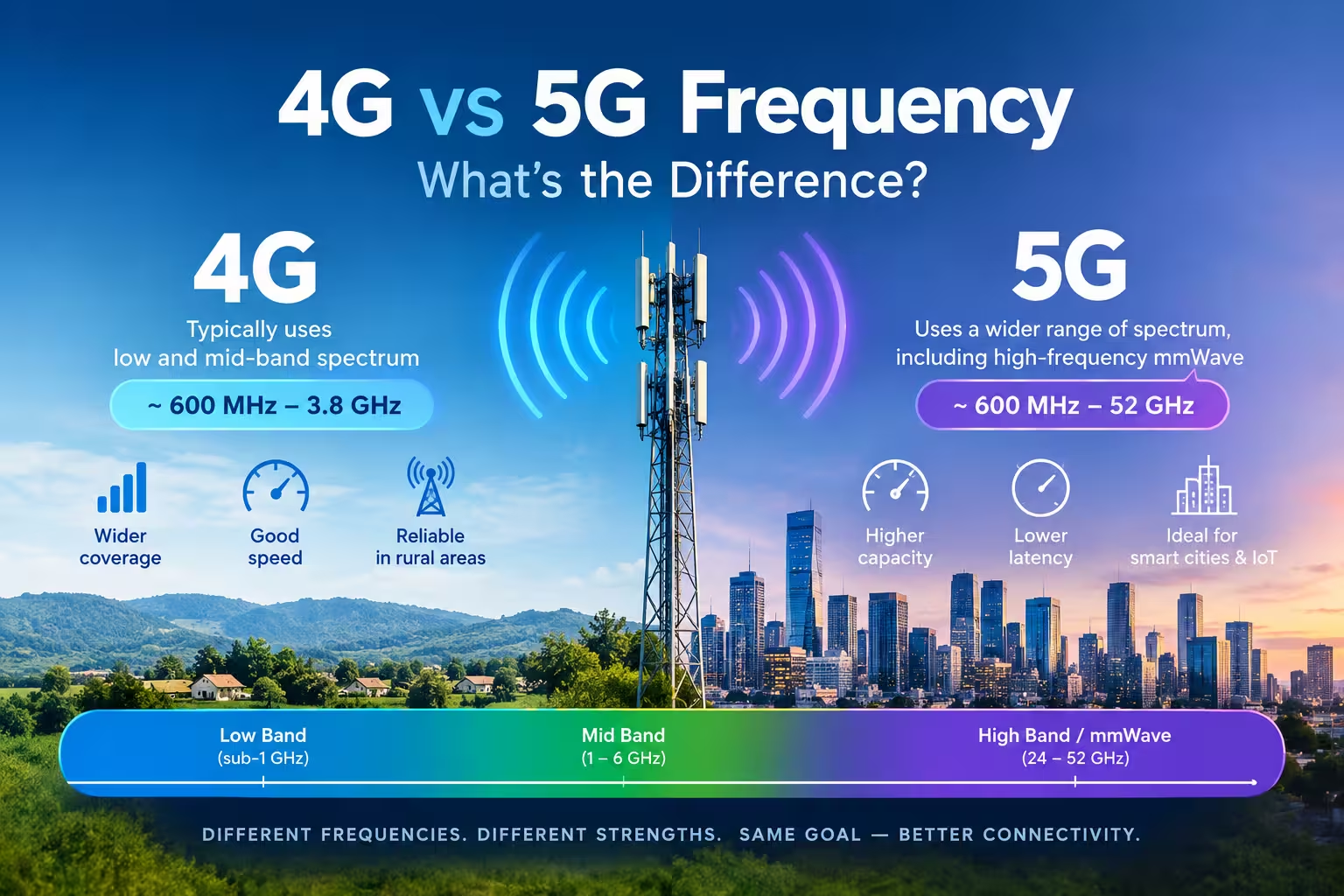
G and 5G can use some of the same low- and mid-band spectrum, but 5G is designed to operate across a much wider range of frequencies, including high-frequency millimeter-wave bands.
The main difference between 4G vs 5G frequency is therefore not simply that 5G always uses a higher frequency. Instead, 5G expands the range of spectrum that mobile networks can use, allowing operators to combine low, mid, and high bands for different coverage and capacity requirements.
Lower frequencies generally travel farther and penetrate buildings better, while higher frequencies can provide more bandwidth and capacity over shorter distances.
4G vs 5G Frequency at a Glance
| Feature | 4G LTE | 5G NR |
|---|---|---|
| Technology | LTE (Long-Term Evolution) | 5G New Radio (NR) |
| Typical spectrum | Low-, mid- and some higher bands | Low-, mid- and high-band spectrum |
| Low-band | Commonly below 1 GHz | Commonly below 1 GHz |
| Mid-band | Commonly around 1–3.8 GHz | Commonly around 1–7 GHz, depending on deployment |
| High-band | Limited compared with 5G | Includes mmWave bands above 24 GHz |
| Coverage | Generally wider at lower frequencies | Varies greatly by frequency band |
| Capacity | High | Higher, especially with wider channels |
| Typical use | Mobile broadband, calls, streaming | Mobile broadband, fixed wireless, IoT and other high-capacity applications |
The exact frequency bands available for 4G and 5G vary by country, operator and spectrum allocation.
What is the Difference Between 4G and 5G Frequency?
The simplest way to understand the difference is that 5G supports a broader selection of spectrum than 4G and can make greater use of very high-frequency bands.
4G LTE operates across numerous frequency bands. These include low-frequency bands used for wide coverage as well as mid-band frequencies used to provide additional capacity.
5G NR also uses low- and mid-band spectrum, but it adds support for high-frequency spectrum, including millimeter-wave (mmWave) bands.
This gives 5G operators more options for balancing:
- Coverage
- Speed
- Network capacity
- Latency
- Indoor and outdoor performance
3GPP maintains the technical specifications for LTE and 5G NR frequency bands. Its LTE specifications include operating bands extending into the 3 GHz range and beyond, demonstrating why it is inaccurate to describe 4G as being limited to 2.5 GHz.
What Frequency Does 4G Use?
There is no single 4G frequency.
4G LTE uses many different frequency bands around the world. Depending on the country and carrier, LTE can operate at frequencies ranging from below 1 GHz to several GHz.
Examples include:
- 700 MHz
- 800 MHz
- 850 MHz
- 900 MHz
- 1.8 GHz
- 2.1 GHz
- 2.3 GHz
- 2.5–2.6 GHz
- 3.4–3.8 GHz
The exact bands available depend on national spectrum allocations and the mobile operator.
Why Does 4G Use Different Frequencies?
Different frequencies have different propagation characteristics.
Lower-frequency LTE bands can cover larger geographic areas and generally penetrate buildings better. Higher-frequency bands can provide additional capacity but usually cover a smaller area from each cell site.
This is why mobile operators often combine multiple LTE bands using technologies such as carrier aggregation.
What Frequency Does 5G Use?
5G also does not have one universal frequency.
5G NR can operate across several frequency ranges, commonly described as:
Low-band 5G
Low-band 5G generally uses spectrum below 1 GHz.
These frequencies offer:
- Wide coverage
- Better building penetration
- Longer range
- Lower capacity than higher-frequency spectrum
Low-band 5G can therefore provide broad-area coverage while still offering improvements over older network technologies.
Mid-band 5G
Mid-band spectrum is particularly important for 5G because it provides a balance between coverage and capacity.
Examples include frequencies around:
- 2.5 GHz
- 3.3–3.8 GHz
- Other country-specific mid-band allocations
Mid-band 5G is often considered the “sweet spot” because it can provide substantially more capacity than low-band spectrum without the extremely short range associated with some mmWave deployments.
High-band 5G and mmWave
5G can also operate in high-frequency millimeter-wave spectrum.
In the United States, for example, the FCC has made spectrum in bands such as 24 GHz, 28 GHz, 37 GHz, 39 GHz and 47 GHz available for high-band wireless services. The FCC notes that high-band frequencies do not propagate as far as low-band frequencies.
These frequencies can provide extremely wide channels and very high capacity, but their propagation range is generally shorter.
4G vs 5G Frequency Range
A common question is:
“What is the frequency range of 4G compared with 5G?”
There isn’t one universal range for either technology.
A better comparison is:
4G LTE: Uses numerous bands from below 1 GHz through several GHz, depending on the LTE band and country.
5G NR: Uses low- and mid-band spectrum as well as high-frequency mmWave spectrum. 3GPP continues to define and update supported NR bands; for example, its specifications include work involving spectrum up to the 6 GHz range and beyond.
Therefore, the often-repeated statement that “4G is 600 MHz–2.5 GHz and 5G is 600 MHz–52 GHz” is an oversimplification.
It is more accurate to discuss the specific frequency bands and frequency ranges used by each network deployment.
Does 5G Use the Same Frequency as 4G?
Yes, in some cases.
5G can use spectrum that is also suitable for 4G, depending on the operator’s network configuration and spectrum allocation.
For example, operators can deploy 5G in low-band spectrum while continuing to operate 4G in other portions of their available spectrum.
Some networks also use Dynamic Spectrum Sharing (DSS) to allow LTE and 5G NR to share spectrum dynamically.
This has helped some operators introduce 5G without immediately dedicating an entirely new block of spectrum to the technology.
Does 5G Have a Higher Frequency Than 4G?
Sometimes, but not always.
This is one of the most important points when comparing 4G and 5G frequency.
A low-band 5G signal can operate at a frequency similar to a low-band 4G signal.
For example, both technologies can use spectrum below 1 GHz.
However, 5G can also operate in much higher-frequency mmWave spectrum, where very large amounts of bandwidth can be available.
So:
5G is not necessarily higher frequency than 4G, but 5G supports a wider range of frequencies and makes greater use of high-frequency spectrum.
Why Does Frequency Matter for 4G and 5G?
Frequency has a major effect on how a wireless signal behaves.
Lower frequencies
Lower frequencies generally:
- Travel farther
- Cover larger areas
- Penetrate buildings more effectively
- Require fewer sites for broad coverage
This makes them useful for rural areas and wide-area mobile coverage.
Higher frequencies
Higher frequencies can:
- Provide more available bandwidth
- Support higher network capacity
- Deliver very high speeds under suitable conditions
- Work well in dense areas with high traffic
However, they generally have shorter propagation ranges and can be more affected by physical obstructions.
The FCC similarly notes that low-band spectrum is useful for wide-area and indoor coverage, while high-band spectrum does not propagate as far and can be reused across more closely spaced cells.
Why Is 5G Faster Than 4G?
Frequency is only one part of the explanation.
5G’s performance improvements come from a combination of technologies and spectrum capabilities.
These include:
- Wider channels
- More available spectrum
- Massive MIMO
- Beamforming
- Improved antenna technologies
- More efficient use of radio resources
- Network densification
- New 5G NR radio capabilities
This means it would be misleading to say that higher frequency alone makes 5G faster.
A mid-band 5G network, for example, can deliver excellent performance without using mmWave frequencies.
4G vs 5G Frequency and Speed
Higher frequency does not automatically mean higher speed.
What matters is also the amount of bandwidth available.
A simplified example:
- A low-frequency network with a narrow channel may provide modest speeds.
- A mid-band 5G network with a wide channel can provide much higher capacity.
- A high-band mmWave network can provide extremely high capacity when the user is close enough to the cell and conditions are favorable.
This is why real-world 5G performance varies considerably between networks.
4G vs 5G Frequency and Coverage
Frequency also affects coverage.
4G
4G networks have been widely deployed using low- and mid-band frequencies. This allows operators to provide relatively broad coverage, including in rural areas.
5G
5G uses a mixture of:
- Low-band spectrum for coverage
- Mid-band spectrum for the balance between coverage and capacity
- High-band spectrum for very high capacity over shorter distances
Consequently, not all 5G has the same coverage.
A low-band 5G connection can have coverage characteristics relatively similar to low-band LTE, while mmWave 5G can require much denser infrastructure.
4G vs 5G Frequency: Which Is Better?
Neither technology is simply “better” because of frequency.
It depends on what you need.
4G LTE may be preferable when:
- Wide coverage is the priority
- 5G is unavailable
- You are in a rural or remote area
- Your device does not support 5G
5G may be preferable when:
- The network has good 5G coverage
- You need higher capacity
- You are in a congested urban area
- Your device supports the available 5G bands
- You need lower latency for supported applications
In many locations, the best real-world connection may depend more on the specific network band and signal conditions than on whether the phone displays 4G or 5G.
Frequently Asked Questions
Is 5G a higher frequency than 4G?
Not necessarily. 5G can use low frequencies similar to those used by 4G, but it also supports higher-frequency spectrum, including mmWave bands.
What is the main frequency difference between 4G and 5G?
The main difference is that 5G supports a broader range of spectrum and can use high-frequency bands that provide very large amounts of bandwidth.
Does 5G use the same frequency as 4G?
It can. 5G and 4G can operate in similar low- and mid-band spectrum, depending on the network and country.
What is the highest frequency used by 5G?
There is no single worldwide maximum frequency for every 5G deployment. 5G NR supports multiple frequency ranges and specific operating bands defined by 3GPP. High-band 5G deployments include frequencies above 24 GHz, particularly in mmWave spectrum.
Why does 5G have a shorter range?
Higher-frequency signals generally experience greater propagation loss and are more affected by obstacles. This is particularly relevant to mmWave 5G.
Does higher 5G frequency mean faster internet?
Not automatically. Speed depends on frequency, available bandwidth, network configuration, signal quality, congestion, device capabilities and other factors.
Is 2.4 GHz 5G?
No. 2.4 GHz is a frequency, while 5G can refer to the fifth generation of cellular technology.
The term can be confusing because Wi-Fi networks can also use 2.4 GHz and 5 GHz bands. A 5 GHz Wi-Fi network is not the same thing as a 5G cellular network.
Conclusion
The biggest difference in 4G vs 5G frequency is not simply that 5G operates at a higher frequency.
Instead, 5G supports a broader range of spectrum and can combine low-, mid-, and high-frequency bands to deliver different combinations of coverage, capacity and speed.
4G LTE also operates across many frequency bands, including low- and mid-band spectrum and some bands above 2.5 GHz. Therefore, saying that 4G “ends at 2.5 GHz” is not accurate.
For 5G, low-band frequencies provide broad coverage, mid-band frequencies offer a strong balance between coverage and capacity, and high-band/mmWave spectrum can provide very high capacity over shorter distances.
Ultimately, the frequency used by your phone depends on the country, carrier, network deployment, device and available spectrum.
Sources
- 3GPP — LTE and 5G NR technical specifications and frequency-band work.
- Federal Communications Commission (FCC) — information on low-, mid- and high-band spectrum and propagation characteristics.
Citations:
- Federal Communications Commission (FCC).
“Understanding Spectrum: How 5G Works.”
https://www.fcc.gov/5G - 3rd Generation Partnership Project (3GPP).
“5G NR Frequency Bands (Release 17).”
https://www.3gpp.org/ - Qualcomm Technologies.
“What is 5G and how is it different from 4G?”
https://www.qualcomm.com/5g/what-is-5g - GSMA Intelligence.
“5G Spectrum Guide: Global Policy and Deployment.”
https://www.gsma.com/spectrum/5g-spectrum-guide/ - ITU (International Telecommunication Union).
“IMT-2020 (5G) Standards and Frequency Bands.”
https://www.itu.int/en/ITU-R/ - Ofcom (UK Communications Regulator).
“Spectrum for Mobile and Wireless Broadband: 4G and 5G.”
https://www.ofcom.org.uk/ - Ericsson Mobility Report.
“The Evolution from 4G to 5G.”
https://www.ericsson.com/en/reports-and-papers/mobility-report - Nokia.
“5G Frequency Bands Explained: Low, Mid, and High.”
https://www.nokia.com/networks/5g/ - IEEE Spectrum.
“Inside the 5G Revolution: Frequency, Speed, and Infrastructure.”
https://spectrum.ieee.org/5g - GSMArena Tech Encyclopedia.
“LTE (4G) and NR (5G) Frequency Bands Explained.”
https://www.gsmarena.com/
Also see: