
A relative frequency bar chart compares sound and brainwave frequencies side by side so you can see how bass, midrange, treble, musical notes and brainwave bands relate to each other. Longer or further-right bars mean higher frequencies, measured in hertz (Hz), where 1 Hz equals one cycle per second.
How to Read This Relative Frequency Bar Chart
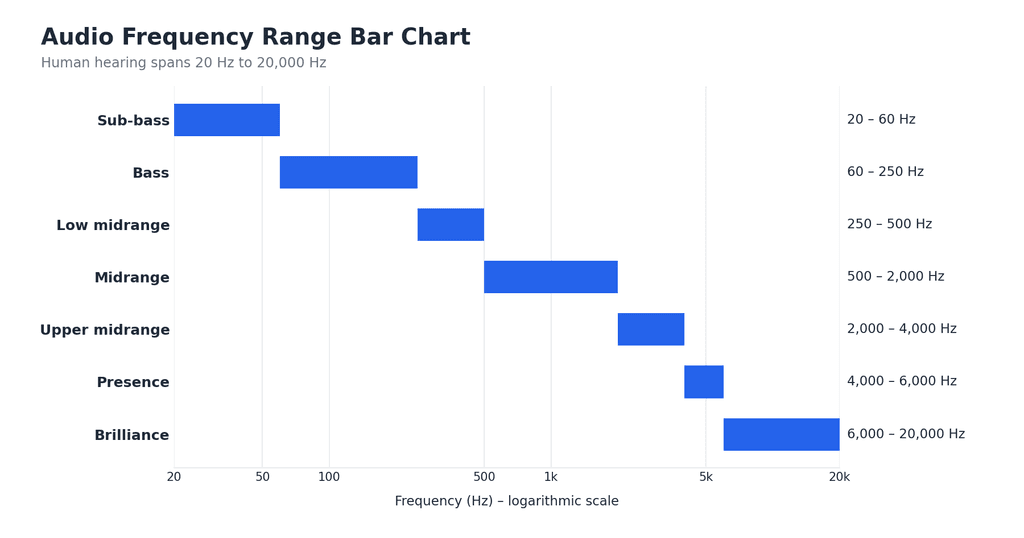
Human hearing spans from 20 Hz to 20,000 Hz, a 1,000-fold difference. To fit that on one screen, the audio and brainwave charts use a logarithmic scale, so each equal step in width represents the same multiplication in frequency, not the same number of Hz. The musical note chart uses a simple linear scale because its values are close together.
Audio Frequency Range Bar Chart (20 Hz – 20,000 Hz)
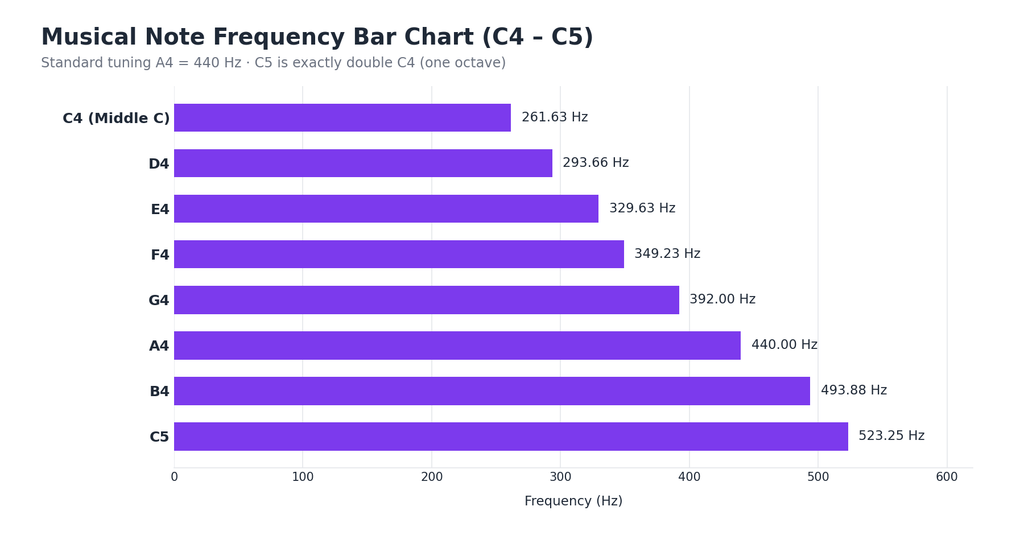
Musical Note Frequency Bar Chart (C4 – C5)
Bar length is proportional to frequency, with C5 (523.25 Hz) as the full bar. Standard tuning: A4 = 440 Hz.
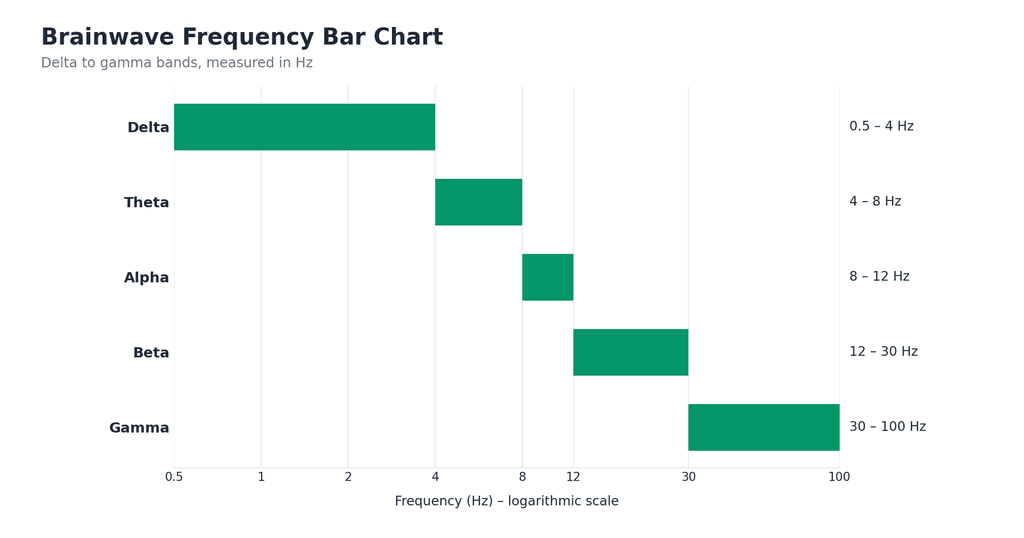
Brainwave Frequency Bar Chart (0.5 Hz – 100 Hz)
Frequently Asked Questions
What is a relative frequency bar chart?
It is a bar chart that shows how one frequency (or range) compares with others, so you can judge differences at a glance instead of reading a list of numbers.
Why use a logarithmic scale for Hz?
Human hearing perceives pitch in ratios, not equal Hz steps. Doubling the frequency always sounds like one octave, so a log scale matches how we actually hear.
Which frequency range is widest?
Brilliance (6,000 to 20,000 Hz) covers the most Hz, but on a log scale the bass and midrange bands take up more visual space because they cover more octaves of useful musical content.
Summary
This relative frequency bar chart shows how audio ranges, musical notes and brainwave bands compare in hertz. Audible sound runs from 20 Hz to 20,000 Hz, from sub-bass rumble up to bright cymbal “air.” Notes in the fourth octave sit between 261.63 Hz and 523.25 Hz, with every octave doubling the frequency, and brainwaves range from slow delta waves at 0.5 Hz to fast gamma waves near 100 Hz. Logarithmic bars make these huge differences easy to compare, so use this chart as a quick visual reference for music, audio mixing or sound study.
Important Resources
Terahertz to Kilohertz Calculator
Milliseconds to Hertz Converter
Hertz to Milliseconds Converter
db to hz calculator